

A Hybrid Approach to Native App Development for a FinTech Platform
froots had built a successful web-based investment platform that allowed users to manage portfolios, complete KYC onboarding, and access financial education. As user expectations evolved, the demand for native mobile access became clear.
The challenge wasn't just technical—it was also strategic. How could froots deliver a native app experience quickly without abandoning their existing web infrastructure or spending months rebuilding from scratch?
Customer
froots
Type
iOS & Android Mobile App
Industry
Financial Technology
Duration
3 Months
Country
Austria
Starting Off with Goals in Mind
1
Bring FinTech to Mobile
Transform the successful web application into native iOS and Android apps to meet user demand for on-the-go investment management.
2
Maintain User Experience Quality
Deliver a truly native app experience that matches the quality and functionality of the existing web platform without compromising on feel or performance.
3
Accelerate Time to Market
Launch a complete mobile solution in just three months without blowing the budget or losing months in development.
Phase 1
Solution Finding Process
How we did it
To solve the challenge of implementing a native app within just three months while maintaining the same quality as the web app and delivering an authentic native feeling, we evaluated three approaches:
.webp)
A: WebView Wrapper
Render all screens as web views to save time and resources. However, no matter how well implemented, it's simply not a native app—and the Apple App Store doesn't allow apps that could just as well be opened in a browser. It was discarded quickly.

B: Fully Native Development
Technically clean and optimal in the long run, but starting completely from scratch would take months and render all existing web app features unusable. Added to this are ongoing synchronisation problems between the platforms.

C: The Hybrid Approach
Instead of going to extremes, we decided on a mix. Core functionalities would be developed natively—what users use most frequently and what needs to feel like a "real" app. Secondary functionalities would be integrated as WebViews to quickly provide the full range of features.
Our decision
We chose the hybrid approach. It brought several advantages:
• Implementation could start immediately without spending months creating foundations
• Apple App Store requirements were met since enough native functionality was present
• The app feels like a real native app, which it actually is
• Continuous development: as soon as the froots web app is expanded with new features, these can simply be made available in the native app via a new web view
• A single source of truth for feature development
Phase 2
Implementation
Tech Stack
Froots' web app was already built with React and Next.js, making React Native the obvious choice. Code reuse, existing knowledge, and a shared monorepo meant we could hit the ground running.
React Native & Expo: Natural evolution from React/Next.js
Tamagui: Replacing Mantine while keeping design consistent
Monorepo: Share code between web and mobile
Bonus: Expo can render on the web, meaning it could eventually replace the web app entirely. Plus, & has already built multiple Expo apps used by tens of thousands simultaneously—we know how to move fast.

React Native

Expo

Github
Tamagui

Monorepo

Agile Process
Close communication between Froots and & was crucial - we weren't just contractors, but formed a joint team.
Our approach:
• Kanban board for transparent workflow management
• Continuous backlog refinement instead of fixed sprints
• Ongoing exchange between froots and & teams
• Close communication as the foundation for quick iterations
The team integration was crucial to managing the three-month timeline. Instead of lengthy approval cycles, we could make decisions together in real-time.
Challenges
Phase 3
Ship
Ready, Set, Ship!
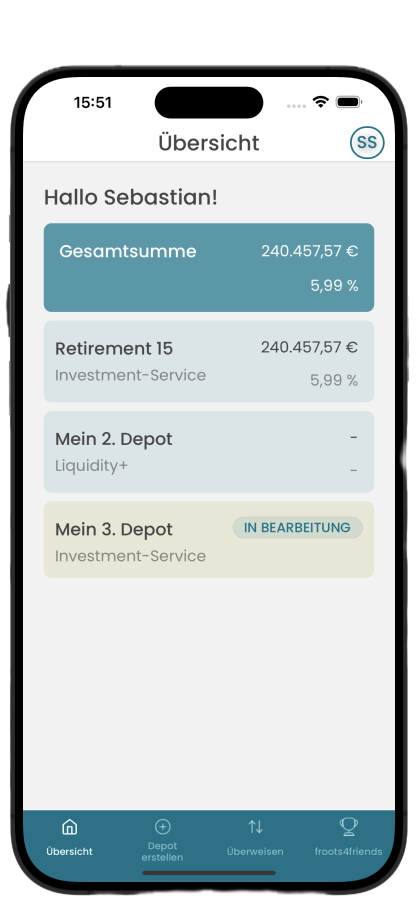
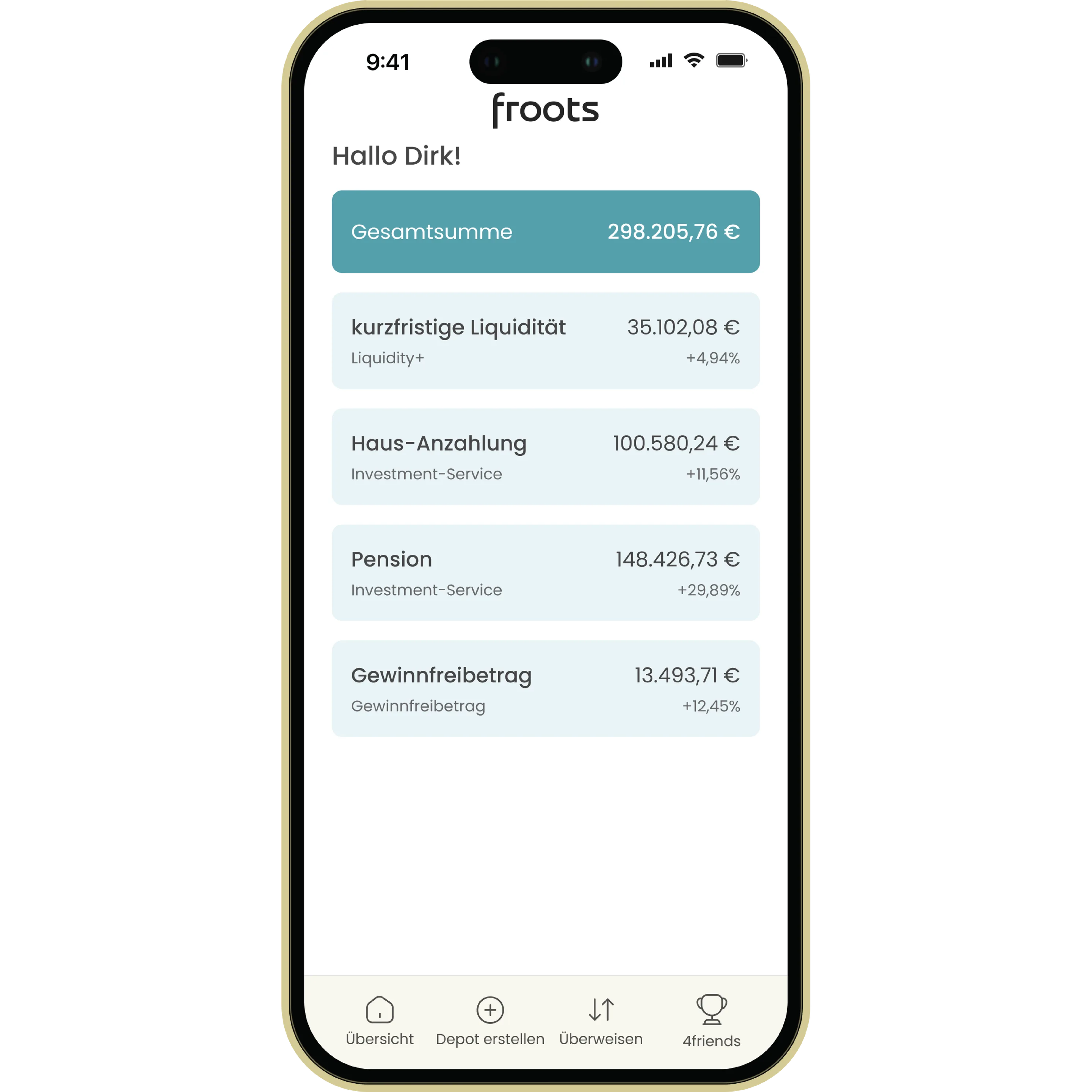
Three months. That's all the time it took to develop a complete mobile app from a vision.Today, froots users can natively manage their financial future on iOS and Android. The complete dashboard with all depots, the thoughtful onboarding flow, the entire transaction history, and depot tracking—everything they know from the web app is also there in the native app. Everything works quickly and intuitively; everything feels like an app that was developed from the ground up for mobile.
This only succeeds when an experienced team relies on proven technologies while proceeding strategically. The project showed us that even the most ambitious goals can be achieved in the shortest time with a methodical approach and the right team setup—while also being really enjoyable.


Impact Unleashed

Georgij Oroschakoff
,
Co-Founder & Head of Product of froots
& is a partner, not just a service provider. Our collaboration was honest, open, proactive, and friendly right from the start. The team is incredibly strong, both professionally and personally. They integrated seamlessly into our corporate culture, were actively involved in finding solutions, and were always happy to go the extra mile to achieve the agreed goals and milestones. The cooperation was very successful, and the final product speaks for itself.
About &
& uses the power of technology to empower people in what they are doing. Depending on your ideas and needs, we develop, shape, and improve software products to increase your digital resilience.
%20Copy.JPG)