
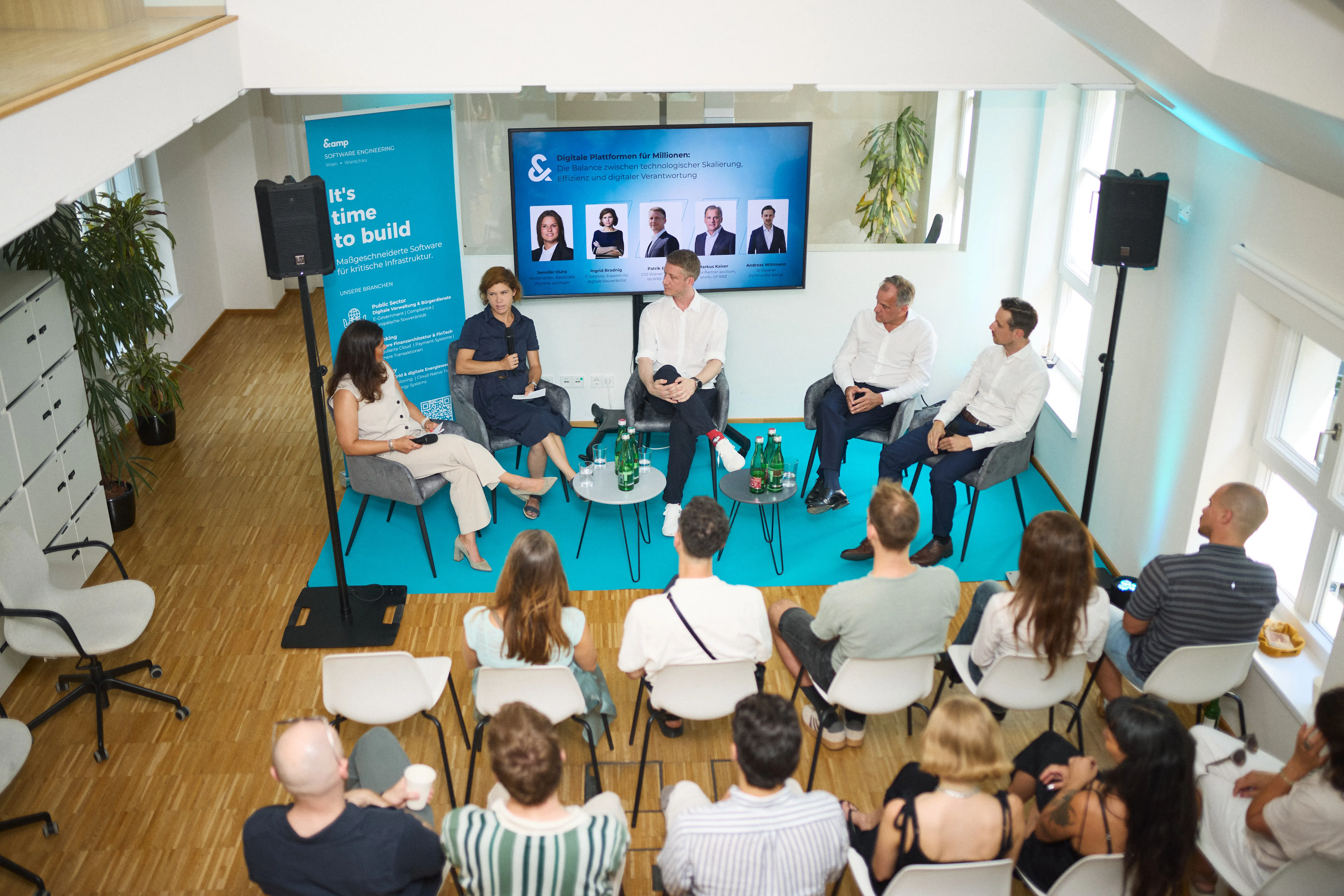
When public institutions build digital platforms for millions of people, it is never about a single function or a clever feature. It is about digital public services: infrastructure that must not fail, must not exclude anyone and has to work just as reliably in five years as on day one.
This tension was the starting point of the panel discussion on 26 June 2026, held for the 5th anniversary of &:
The panel brought together perspectives from journalism, public administration, strategy consulting and engineering. Alongside digital expert Ingrid Brodnig, Wiener Wohnen CIO Patrik Ertler and accilium partner Markus Kaiser, Andreas Wittmann, co-founder of andamp and an expert in AI in software development, completed the line-up of four speakers. Together they looked at the opportunities and challenges for the infrastructure of tomorrow.
The partnership problem: why innovation dies in the pilot
Patrik Ertler, CIO of Wiener Wohnen, sums up the basic problem of many large organisations: they have the power to execute, but not always the view of the market. And they have rules: procurement law, compliance and political priorities. These make experimenting hard.
His answer is deliberately structural: create internal resources that do not disappear with every round of cuts. Build awareness in management that the ability to innovate is not a nice extra but directly tied to resilience in a crisis. And above all: enter targeted, long-term partnerships instead of tendering for service providers.

Markus Kaiser, senior partner at accilium and former managing director of the Austrian Federal Computing Centre (Bundesrechenzentrum), adds three conditions without which scaling rarely succeeds:
- You need someone with real ownership who accompanies a project from the idea to live operation and clears obstacles out of the way.
- You have to work with the production goal in mind from the start, not with the claim of a pilot that is supposed to scale one day.
- Partnership on equal terms is the only environment in which risks can really be discussed openly.
The difference between a pilot that ends up in a drawer and a system that millions of people use every day is organisational and rarely technical.
Whose goals are built into the algorithm?
When a public client deploys an off-the-shelf solution from an international tech company, it never buys just the function. It also buys the business model behind it. And that rarely matches the goals of an administration.
Ingrid Brodnig, author and sharp observer of digital power structures, asks the decisive question: with which business goal was this algorithm developed? Besides the visible benefit for users, many platforms pursue quiet side benefits: longer time spent, click data, training material for AI models. In large international solutions, this side benefit is often hidden so vaguely in the terms and conditions that it is practically impossible to read out.
Her point is a call for clarity: the closer the cooperation between the public sector and tech partners, the more the goals of a system can be aligned with the goals of the administration, and not the other way round. Close cooperation creates transparency, and transparency is the precondition for trust.

Patrik Ertler brings this down to the operational level: at Wiener Wohnen, the organisation deliberately invests more in legal certainty than a private company would. Tenants must be able to rely on their data not ending up on US servers in the future either.
Markus Kaiser adds an uncomfortable finding about the bigger picture: Europe conducts the debate on digital sovereignty too ideologically and with too little fact-based analysis. Instead of ideological debates on principle, a sober look at the actual investments would be the first necessary step.
Inclusion: the most expensive mistake in software development
In most projects, inclusion ends up as the last item on the checklist, shortly before go-live, when budget and time are already used up. What follows is a retrofit that does not scale.
Ingrid Brodnig urges caution here: AI errors differ from human errors because they arise from probabilities. The tricky part is that the error rate, around five percent, is almost impossible to find when a system otherwise works reliably. Where decisions affect people directly or liability questions arise, this is a real risk.
At the same time she sees a clear opportunity: AI is very well suited for tasks that nobody likes doing and where a small error hardly matters. Her example from journalism: automatically generated subtitles for social media videos, which used to mean three quarters of an hour of manual work per clip. Tasks like this exist in public administration too and free up capacity in teams that are more likely to shrink than grow.
For scaling through inclusion, Markus Kaiser had a concrete example ready. Singapore, with 6 million inhabitants much smaller than Austria, has written inclusion into every digital architecture as a hard design requirement. The result: the central government app reaches 350 million transactions per year. ID Austria reaches 12 million per month. The difference is a matter of design approach, not of population size.
A second example: India has extended its government app with full voice input and output. Those who cannot read simply speak to the app. Inclusion by design here means access regardless of reading skills.

Ingrid Brodnig reduces access to the simplest common denominator: the most important and most often underestimated step towards inclusion is plain language as a basic condition. Accessible means, at its core: do not overcomplicate. Neither in wording nor in menu navigation.
Patrik Ertler makes the social effect tangible: when social workers need ten percent less time for documentation, that is ten percent more time for tenants who have fallen into difficulty. In this context, digitalisation is a direct lever for social participation.
A second, often overlooked effect is transparency itself. Clearer data and processes help customers understand how procedures work and where to turn. For Mr Ertler this is just as direct a contribution to social participation as the time gained.
Andreas Wittmann, co-founder of &, shows how this principle can be put into practice in development, with AI as a continuous companion instead of a check at the end:
"What you can do with AI now is put an accessibility expert right at your desk who watches every feature as it is developed and gives input. That way it does not happen at the end, but alongside the development."
A concrete example from practice: for an Austrian ministry, & built an app in eight to nine languages. The first translation came from professional translators. But an app keeps evolving after launch: new screens, new FAQ entries and so on. Hiring translators again for every small change is unrealistic. Here AI takes over the ongoing maintenance. The same goes for support: users get answers in their own language, even if the conversation was originally held in German. Only for legally sensitive statements does caution remain necessary.
AI in software development: more than a speed lever
The question Andreas Wittmann hears most often about AI in software development is: does it make you faster? His answer at the panel was clear: yes. But that is the least interesting part.
The real gain lies in the entire development process. AI helps to capture requirements more precisely before a single line of code is written. It makes it possible to turn a click dummy into a real, clickable prototype that delivers real user feedback. And it brings knowledge to the table that a single person cannot cover alone, whether for code quality, architecture decisions or accessibility.
Speed is never an end in itself. What counts is better software that reaches more people, that can be operated more securely and that is still maintainable in five years. That is the yardstick by which the use of AI in software development has to be measured.

The questions that remain open
Around 50 minutes of discussion are not enough to settle the questions this topic raises. A few of them stay with us after the panel:
- How much control is a public institution willing to give up so that innovation can really happen? And where is the line beyond which this becomes a sovereignty problem?
- If AI increasingly takes over requirements analysis, prototyping and accessibility checks: who carries the responsibility when a system still excludes people?
- With ID Austria, Austria has taken a first step. Singapore shows where the road can lead. What would it take for inclusion in Austria not to remain the exception but to become the basic condition of every public platform?
- And finally the question the panel ended with: if we meet here again in five years, which technology will we ask ourselves how we ever managed without?
It's time to build: inclusive, sovereign, for millions
At &, we build platforms that have to work for millions of people while staying sovereign, secure and accessible. Our AI-first approach speeds up the development process without endangering the enterprise stability our customers need.
Contact us today for a personal consultation and find out how we can help your organisation.

Explore Our Latest Insights
Stay updated with our expert articles and tips.




Discuss Your Web Development Project with Our Experts Today.
Discover how our tailored web development solutions can elevate your business to new heights.
Stay Connected with Us
Follow us on social media for the latest insights and updates in the tech industry.