
A New Approach to Digital Consultation for Financial Services
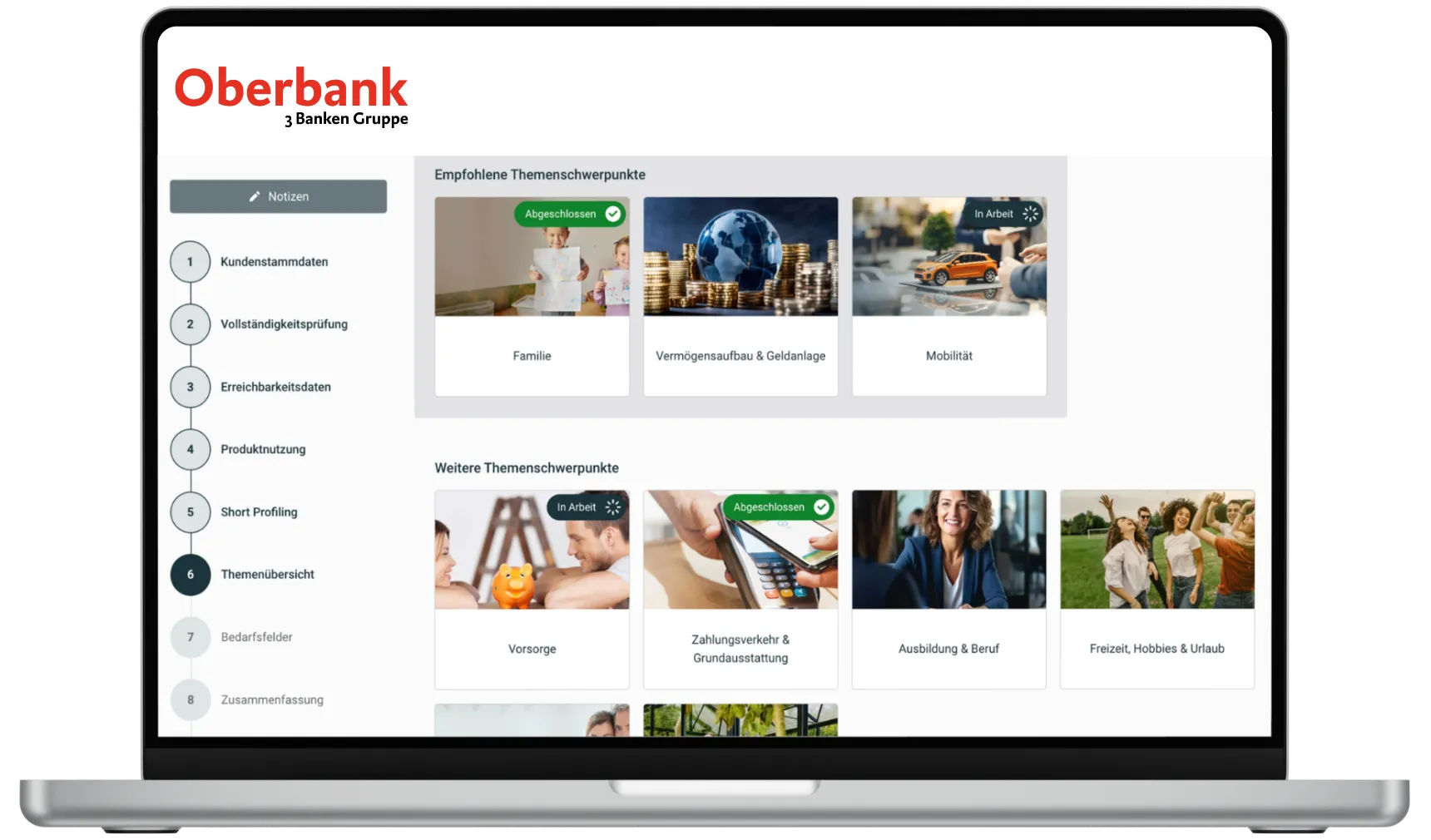
Oberbank utilized a standardized workflow for conducting customer meetings. However, due to its outdated design and poor user experience, the legacy workflow became a post-meeting documentation tool rather than the interactive consultation aid it was intended to be. Additionally, because data was collected in free-text fields, drawing analytical conclusions was difficult. As user expectations evolved, Oberbank recognized the need to shift from passive documentation to a dynamic, visual "consultation experience" displayed directly in advisory rooms and & stepped in to turn that vision into a reality.
Customer
Oberbank
Type
Web Application
Industry
Financial Technology
Duration
6 Months
Country
Austria
Starting Off with Goals in Mind
1
Elevate the Live Consultation Experience
Shift the workflow from post-meeting administration to a live, interactive advisory process that engages customers visually and modernizes the in-branch experience.
2
Unify Workflows and Data Utility
Replace fragmented legacy processes with a consistent advisory standard while transitioning from unstructured notes to structured data capture for advanced analytics and regulatory compliance.
3
Accelerate Advisor Enablement
Implement guided questionnaire logic to empower new or less-experienced advisors to lead high-quality, independent client conversations significantly faster.
Phase 1
Solution Finding Process
How we did it
Right off the start of the project, we faced a challenge: Integrate an externally developed advisory module into a bank's core frontend with minimal overhead while preserving standards, and reusing UI components.
.webp)
A: Integrated Repository Development
Leverage the host’s existing infrastructure or Git Submodules to enable immediate component reuse. This ensures a fast start and low setup costs but ties development to the host’s release cycles.

B: NPM Package
Offers great framework support via an internal registry. However, releases remain tied to the host, and reusing host UI components would require extracting them into a separate shared library.

C: Module Federation
Allows highly independent development and deployment cycles (lazy-loaded). The downside is significantly higher architectural setup costs and the need to package shared components via NPM.

Single-SPA
Converts the entire frontend into a microfrontend architecture for maximum independence, but the initial setup and ongoing maintenance costs are extremely high.
Our decision
We chose to develop directly within the host application's codebase. While we accepted the trade-off of shared release cycles, this approach delivered critical advantages:
• Immediate Start: Allowed us to meet a strict time budget without battling existing organizational processes.
• Zero Pipeline Changes: Avoided disrupting other teams' infrastructure by leaving existing Angular templates and deployment pipelines intact.
• Trivial Component Reuse: Leveraged the clean host repository to easily move shared UI components into a centralized module.
• Future-Proof: Kept the architecture simple for now, keeping the door open to migrate to Module Federation later if frontend teams scale up.
Phase 2
Implementation
Tech Stack
The bank's frontend was built as a monorepo, using Angular and Nx, making them the obvious choices. Code reuse, existing knowledge, and a Spring Boot microservice architecture meant we could hit the ground running without reinventing the wheel.
Angular: The foundational framework for the frontend, enabling a dynamic, component-driven experience, perfect for multi-step consultation flows with customers.
Nx & Monorepo Frontend: Developing within the same repository allows for sharing of UI components between the host application and the new advisory module.
Spring Boot: Powers the robust backend microservices necessary to communicate securely and in real-time with the core banking systems.
Bootstrap: Provides the responsive, reliable styling framework to maintain a consistent, clean UI design across the advisory screens.
OpenShift: The enterprise container platform used to securely deploy, run, and scale the application within the bank's strict IT infrastructure.
Angular

Monorepo

Spring Boot

Bootstrap

Openshift

Agile Process
Close coordination with Oberbank’s internal IT teams was a cornerstone of the project’s success. Rather than working in a silo, we functioned as a strategic partner to their technical experts, ensuring a seamless integration into the bank's existing infrastructure.
Our approach:
• Scrum-driven delivery cycles to maintain a structured, iterative, and predictable pace toward the launch.
• Asynchronous Sprint cycles between & and Oberbank. This staggered approach allowed us to remain in a constant "build-and-review" loop without the teams blocking each other’s progress.
• Joint backlog refinement where business logic, regulatory needs, and technical constraints were discussed and prioritized in real-time.
• Continuous feedback loops between & and Oberbank, ensuring that sprint results were reviewed and adjusted without administrative delay.
This communication-heavy Scrum model was essential for managing the project’s technical complexity within a six-month window. By maintaining an "open-door" policy with Oberbank’s developers, we bypassed traditional approval bottlenecks and maintained a high development velocity without compromising on quality or compliance.
Challenges
Phase 3
Ship
Ready, Set, Ship!
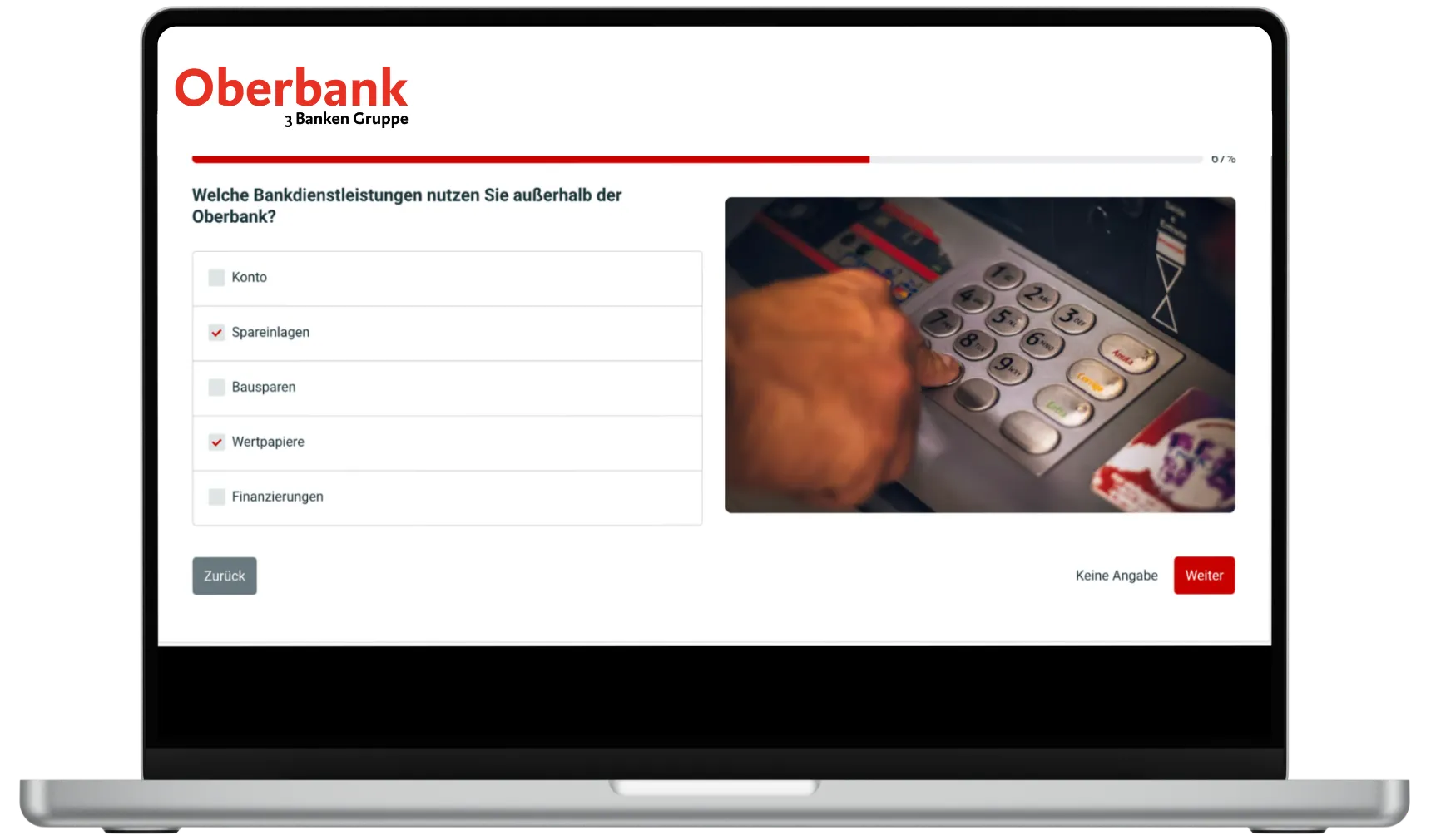
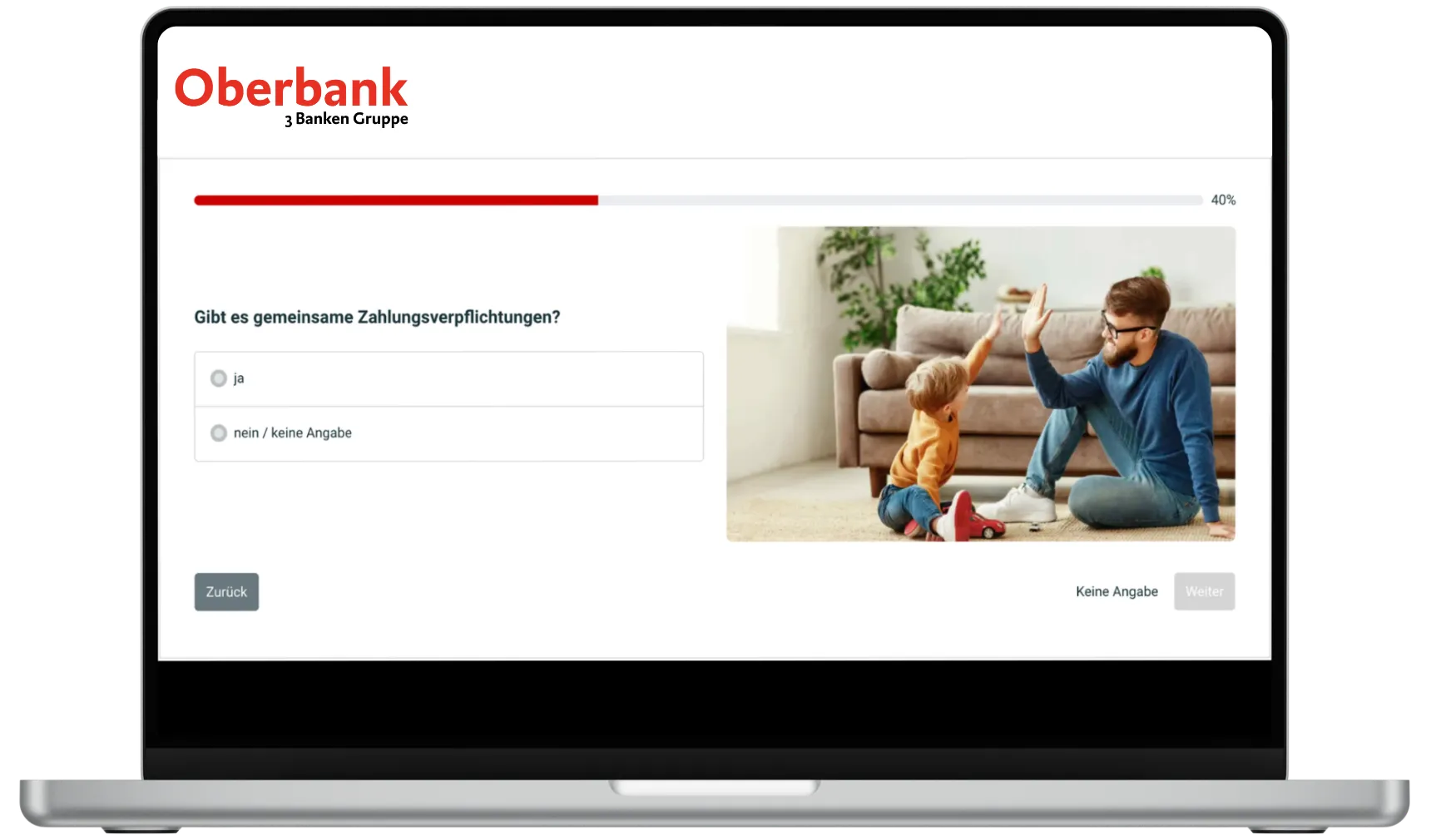
In just six months, we transformed a fragmented administrative process into a collaborative digital journey. Advisors and clients now navigate financial decisions via an intuitive questionnaire, resulting in an automated summary delivered directly to the customer’s eBox. By anchoring development within the bank’s architecture, we bypassed enterprise bottlenecks and demonstrated that complex core-banking integrations can be achieved rapidly through a strategic, pragmatic partnership.

"With & we have gained a partner who meets our high organizational, technical, and professional standards in every aspect. Their extensive experience, solution‑oriented mindset, and hands‑on approach enabled us to achieve significant progress within a short period of time. The collaboration has consistently been trusting, efficient, and highly pleasant on both a personal and professional level. We value & as a reliable, competent, and dedicated partner."

About &
& uses the power of technology to empower people in what they are doing. Depending on your ideas and needs, we develop, shape, and improve software products to increase your digital resilience.